5. Week 4: On Integrals and Volumes
≪ 4. Week 3: Integration by Parts | Table of ContentsCongratulations on making it through a midterm, and an evening midterm no less!
Since it’s right after a midterm has passed, I thought this would be a good time to showcase an application of some of the concepts we’ve seen regarding the integral through some applications.
Problem 1.
The CEO of Bowling wants to make bowling a more glamorous sport, and what better way to do that than make a solid gold statuette in the shape of a bowling pin? The CEO tells you, his consultant, that he has designed a rotationally symmetric bowling pin whose silhouette can be modelled by the equation
\[ x = \pm \sqrt{ - \frac{1}{190} \left( y^4 - 27y^3 + 238y^2 - 686y \right)}, \]where \(x\) and \(y\) are in centimeters and \(0 \leq y \leq 12\). Gold has a density of \(19.283 \textrm{g}/\textrm{cm}^3\) and costs $132.62 per gram (as of last Monday night). How much would the gold in such a statuette be worth?
When approached by such a terrible investment opportunity, one may realise that finding the volume suffices to determine the value of the gold in the statuette. Let us now present two methods of computing such a volume.
The Direct Method of Riemann Sums
When we first discussed Riemann sums, we had developed them in the context of finding area beneath a curve. There, we approximated a complicated-looking area by a bunch of simple-looking rectangles, then made the approximation finer and finer. We’ll apply the same logic: we can slice the bowling pin into many horizontal slabs, approximate each slab by a flat cylinder (whose volumes are easy to find), then make the approximation finer and finer.
Let’s first abbreviate the “radius” of the bowling pin at height \(y\) by the expression
\[ r(y) = \sqrt{ - \frac{1}{190} \left( y^4 - 27y^3 + 238y^2 - 686y \right) }. \]Let us first consider a coarse approximation by four cylinders. Each cylinder has a height of 3 centimeters, Although we can fiddle with the radius of each cylinder to make it roughly match the volume of each segment of the bowling pin, let’s be a bit more systematic and make the radius of each cylinder line up with the radius of the bowling pin at its top face. Thus our four cylinders have radii \(r(3)\), \(r(6)\), \(r(9)\), and \(r(12)\), and they have volumes \(3\pi r(3)^2\), \(3\pi r(6)^2\), \(3\pi r(9)^2\), and \(3\pi r(12)^2\). Note the topmost cylinder is empty since its radius is \(0\).
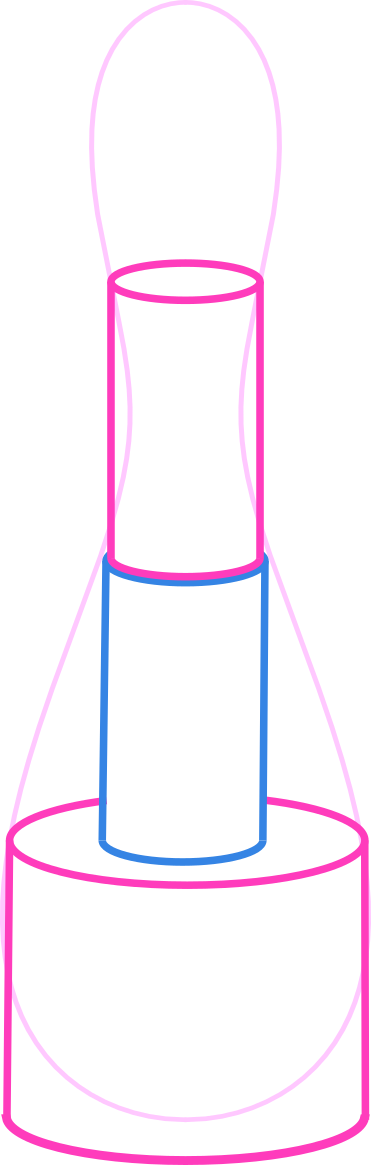
Adding them all up to approximate the volume, we may express our rough answer as
\[ \textrm{Volume}\approx \sum _{n=1}^{4} 3\pi r(3n)^2. \]Now the CEO of bowling probably isn’t very happy with a 4-cylinder approximation of his golden statuette, but fortunately we may repeat the argument with as many cylinders as we want! If we had \(N\) cylinders, then each cylinder would have a height of \(\frac{12}{N}\) cm, and the \(n\)-th cylinder would have a radius of \(r\left(\frac{12}{N}\cdot n\right)\) cm. Summing their volumes yields
\[ \textrm{Volume}\approx \sum _{n=1}^{N} \frac{12}{N} \pi r\left( \frac{12}{N}\cdot n \right)^2. \]This looks a lot like a Riemann sum! Sending \(N\) to infinity therefore should give us an integral, and we get
\[ \begin{align*} \textrm{Volume} &= \lim _{N\to\infty} \sum _{n=1}^{N} \frac{12}{N} \pi r\left( \frac{12}{N}\cdot n \right)^2 \\ &= \int _{0}^{12} \pi r(y)^2 dy \\ &= \frac{8064}{475}\pi \textrm{ cm}^3 \\ &= 53.3343224\ldots \textrm{ cm}^3. \end{align*} \]Using the density of gold and the price per gram of gold, we arrive at a cost of $136,392.47.
I called this the “direct method” because there is something very concrete about manually approximating these volumes using cylinders. But maybe you don’t like Riemann sums, and you think calculus should’ve been left the way it was back when Newton and Leibniz were still wrestling with each other. This brings us to…
The Indirect Method of Antiderivatives
“Work smarter, not harder,” goes the old adage, and why should I try to find the volume of a million cylinders? We have the fundamental theorem of calculus at our disposal and we ought to use it.
Let’s begin with the rather mysterious move of defining \(V(y)\) to be the volume of the bowling pin if we cut off everything above \(y\) cm. So \(V(4)\) would be the volume of the bottom-most \(4\) cm of the bowling pin, for instance.
While \(V(y)\) as a function is kind of complicated to understand, we can instead study its derivative. If we can determine \(V'(y)\) without much effort, we can then integrate \(V'(y)\) to recover what \(V(y)\) should have been, and in particular we’ll be able to find \(V(12)\), the volume of the whole bowling pin.
Now recall the limit definition
\[ V'(y) = \lim _{h\to 0} \frac{V(y + h) - V(y)}{h}. \]For simplicity we’ll consider \(h > 0\), but the argument works the same in any case. \(V(y+h)\) is the volume of everything less than \(y+h\) cm above the ground, while \(V(y)\) is the volume of everything less than just \(y\) cm above the ground, thus the different \(V(y+h) - V(y)\) is the volume of whatever’s between \(y\) and \(y+h\) cm off the ground. When \(h\) is pretty small, I imagine this as the volume of a rather shallow cone collar shaped region, maybe the remains of a badly mutilated cone.
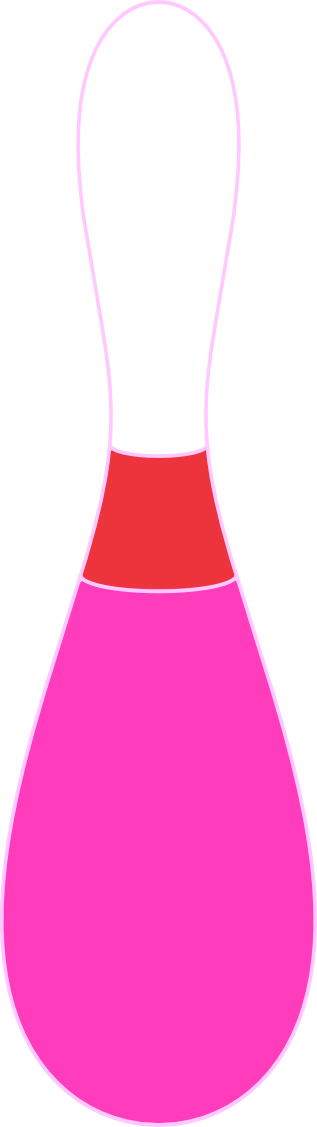
Here, \(V(y)\) is the pink volume and \(V(y+h)-V(y)\) is the red volume. The unshaded portion is everything above \(y+h\).
But the volume that \(V(y+h) - V(y)\) represents is really close to that of a cylinder, namely a cylinder with height \(h\) and radius \(r(y)\) (or \(r(y+h)\))! So we have \(V(y+h) - V(y) \approx h \pi r(y)^2\), with this becoming a better and better approximation as \(h\to 0\), and therefore we conclude
\[ V'(y) = \lim _{h\to 0} \frac{h \pi r(y)^2}{h} = \pi r(y)^2. \]Now by the fundamental theorem of calculus, we have
\[ V(12) - V(0) = \int _{0}^{12} V'(y) dy, \]and using \(V(0) = 0\) (there’s no bowling pin underground), we conclude
\[ V(12) = \int _{0}^{12} \pi r(y)^2 dy, \]exactly as we had with the Riemann sums.
Both interpretations are equally valid, and philosophically they’re two ways of saying exactly the same thing. It’s up to you which one you want to use more.
Exercise 2.
Three French mathematicians, embroiled in a fight for liberty and equality during the French Revolution, happen upon a perfectly spherical watermelon, a foot in diameter. In the name of equality they want to cut it into three equal pieces, but to their dismay their only cutting implement is a guillotine. How thick should they make the first slice so that it’s exactly a third of the watermelon?