6. Week 5: Trigonometric Substitutions
≪ 5. Week 4: On Integrals and Volumes | Table of Contents | 7. Week 6: Infinite Finite Integrals and Finite Infinite Integrals and Infinite Infinite Integrals ≫Last week, you should have been exposed to the method of trigonometric substitutions. This is often presented with the algebraic identities
\[\begin{align*} 1 - \sin^2 \theta = \cos^2 \theta && \textrm{ and } && \sec^2 \theta - 1 = \tan^2 \theta \end{align*}\]as the “star players”, but today we will take another perspective and systematise this technique using the triangle as the “star player”. It is completely up to you which approach you take; choose the one that speaks to your heart the most.
Integrals involving something of the form \(\sqrt{x^2 + 1}\), \(\sqrt{x^2-1}\), or \(\sqrt{1-x^2}\) (but not more than one of these!) can all be handled with this method. Let’s first outline the steps we’ll take, then do two illustrative examples.
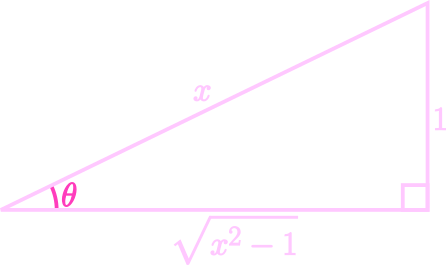
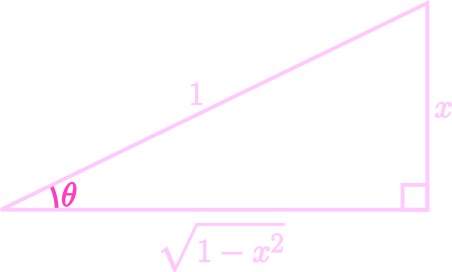
- Draw a right triangle with two sides of length \(1\) and \(x\). Find the length of the missing side using the Pythagorean theorem and choose different sides for \(1\) and \(x\) if the squarerooted term doesn’t resemble your integrand. Label one of the acute angles \(\theta \).
- Rewrite the integrand in terms of \(\theta \) by using the trigonometric ratios \(\sin \theta \), \(\cos \theta \), and/or \(\tan \theta \) (recall soh-cah-toa).
- Write \(x\) in terms of \(\theta \) using the previous step and find \(\frac{dx}{d \theta }\). Use this to rewrite \(dx\) in terms of \(d \theta \).
- Solve the integral, which should now be in terms of \(\theta \).
- Using the triangle, rewrite everything involving \(\theta \) back in terms of \(x\).
This process can be quite a bit to take in, so let’s demonstrate this with an example.
Example 1.
Compute
\[ \int \frac{1}{x^2\sqrt{x^2-1}} dx. \]Step 1. Drawing the Triangle
Step 2. Rewriting the Integrand
Since \(\sin \theta = \frac{1}{x}\), \(\cos \theta = \frac{\sqrt{x^2-1}}{x}\), and \(\tan \theta = \frac{1}{\sqrt{x^2-1}}\), we may rewrite the integral as
\[ \int \frac{1}{x^2\sqrt{x^2-1}} dx = \int \sin^2 \theta \tan \theta\ dx. \]Step 3. Rewriting \(dx\)
Returning to \(\sin \theta = \frac{1}{x}\), we have \(x = \frac{1}{\sin \theta } = \csc \theta .\) Therefore, \(\frac{dx}{d \theta } = - \csc \theta \cot \theta \), or equivalently \(dx = - \csc \theta \cot \theta d \theta .\) Putting this into our integral, we have
\[\begin{align*} \int \frac{1}{x^2\sqrt{x^2-1}} dx &= \int \sin^2 \theta \tan \theta\ dx \\ &= -\int \sin^2 \theta \tan \theta \csc \theta \cot \theta\ d \theta \\ &= - \int \sin \theta d \theta . \end{align*} \]Step 4. Integrating!
I hope we can all perform
\[ \int \frac{1}{x^2\sqrt{x^2-1}} dx = - \int \sin \theta d \theta = \cos \theta + C. \]Step 5. Going back to \(x\)
Finally, we can return to our triangle in step \(1\) to get
\[ \int \frac{1}{x^2\sqrt{x^2-1}} dx = \cos \theta + C = \frac{\sqrt{x^2-1}}{x} +C . \]Let’s now do a somewhat more difficult example.
Example 2.
Compute
\[ \int \frac{\sqrt{1-x^2}}{x} dx. \]Although you may be tempted to try a substitution \(u = 1-x^2\), it doesn’t quite work out; you can likewise try integration by parts, but there is no good way to handle the \(\sqrt{1-x^2}\).
Step 1. Drawing the Triangle
Step 2. Rewriting the Integrand
Looking at the integral, we can then use the identities \(x = \sin \theta \) and \(\sqrt{1-x^2} = \cos \theta \) to get
\[ \int \frac{\sqrt{1-x^2}}{x} dx = \int \frac{\cos \theta }{\sin \theta } dx. \]Step 3. Rewriting \(dx\)
Revisiting \(x = \sin \theta \) and differentiating both sides, we get
\[ \frac{dx}{d \theta } = \frac{d}{d \theta }\sin \theta = \cos \theta \quad \implies \quad dx = \cos \theta\ d \theta . \]Substituting this in, we arrive at
\[ \int \frac{\cos ^2 \theta }{ \sin \theta } d \theta . \]Step 4. Integrating!
This may look impossible, but fret not! We can apply the identity \(\cos ^2 \theta = 1 - \sin^2 \theta \) and rewrite this integral as
\[ \int \frac{1 - \sin^2 \theta }{\sin \theta }d \theta = \int (\csc \theta - \sin \theta ) d \theta. \]The identity \(\int \csc \theta = - \ln \left\lvert \csc \theta + \cot \theta \right\rvert +C\) is provided to you for free (subsidised by your tuition), hence we get
\[ \int \frac{\sqrt{1-x^2}}{x} dx = - \ln \left\lvert \csc \theta + \cot \theta \right\rvert + \cos \theta + C. \]Step 5. Going back to \(x\)
Use the triangle! \(\csc \theta = \frac{1}{x}\), \(\cot \theta = \frac{\sqrt{1-x^2}}{x}\), and \(\cos \theta = \sqrt{1-x^2}\), and therefore we may finally conclude
\[ \int \frac{\sqrt{1-x^2}}{x} dx = - \ln \left\lvert \frac{1}{x}+\frac{\sqrt{1-x^2}}{x} \right\rvert + \sqrt{1-x^2} + C. \]Oh goodness this last example was quite taxing. The most important thing to remember is that after a trig sub, you may have to pull out some algebraic tricks like we just did, or even continue with another substitution, or a round of integration by parts, etc.
Remark 3.
The choice of which angle is called \(\theta \) doesn’t matter. Although the answer you get is sometimes different depending on which angle you use, it turns out it’s always mathematically self-consistent! So do not worry about the order of the legs or the orientation of the angle.
Here’s two more practise problems to consolidate this concept. These come with an additional hurdle in setting up the triangle: you may have to do some more algebra to get things set up.
Practise 4.
Compute
\[ \int \frac{1}{\left( x^2+2x+10 \right) ^{\frac{5}{2}}} dx. \]Hint for the triangle.
Hint for the \(\theta \)-integral.
Practise 5.
Compute
\[ \int x^3\sqrt{4-9x^2} dx. \]